David Colin Rockola (sometimes recorded as David “Cullen” Rockola) was born in Virden, Manitoba, Canada in 1897. Despite the Italian sounding musicality of the name, his father George was actually of Russian descent. George was also an amateur inventor and worked for a pump company, but it’s hard to say he inspired his son’s interest in machines. The fourth of five kids, David had already endured the divorce of his parents and the death of his mother by age 13, essentially ending his childhood ahead of schedule. Shortly thereafter, he left his home and school to try to make his way in the world. It was a journey into the Canadian wilderness—only instead of mountains and forests, David Rockola was moving from town to town, learning the merchant trade and growing unusually street smart and tough nosed for his age.

He was a bellhop in Saskatoon, then—while still a teenager—opened up his own cigar shop in another hotel in Medicine Hat, Alberta. He recounted the experience in a 1987 interview with a high school student named LeAnn Turbyfill—a cub reporter for her school paper in Kentland, Indiana.
“I went into the cigar business in this hotel and of course, like a fool, I worked all day and night,” Rockola said, hinting at an obsessive streak. “I ended up in the Medicine Hat hospital because I worked too many hours. I had diphtheria fever. They took my cigar store away from me.”
Undeterred, Rockola regrouped in Calgary, briefly running another cigar shop until the fates intervened to his benefit. According to one version of the tale (there are a few), two Australians came in the store one day and offered Rockola a ‘trade stimulator’, a type of coin-operated gumball machine that dispensed prizes—like vouchers for items in the shop. In short order, Rockola’s new machine was getting more business than his cigars, and more attention than the cute girl he’d hired to run the register. Barely 20 years old, he’d found his new life’s calling.
Coin-operated machines, while innocent novelties in many cases, had also generated a fair reputation for trouble by this point in time. For every well-meaning child’s game or weighing scale on the market, there were dozens of shady figures using similar slot gadgets to entice gamblers, rig outcomes, short-change the payouts, and skim off the untraceable profits to avoid taxes. Early on, the baby-faced Rockola seemed to be on the up-and-up with his mechanical interest in the devices. But he may have had his eyes on the bigger prizes down the road.
He went to Toronto to get into the business, and later, at the age of 23, he came to Chicago, working for the top three slot machine manufacturers; Mills, Jennings and Watling.
He used to make the front panels of the slotmachines.
In 1926 / 1927 he started his own vending machine manufacturing company, and soon added scales, known as “the Rockola scale company”.
In 1930 Pinball machines came on the market, and Rockola decided to join the competition. In 1932 he introduced his own pinball game: “Juggle ball”. Unhappily this was not a succes, and it made him nearly bankrupt.

Later on he would produce coin-ops himself, for example the (1930-35?) Rock-ola Revamp:

Strange enough, the “Juggle Ball” and “World Series” are regarded as the most innovative and collectible pingames of the 30’s !

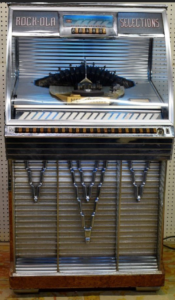
In 1934 David Rockola got his hands on a patent of a mechanism, which could pick a record out of a pile of disks, play it and store it back in its original place. He bought the patent and went directly into production, which was an excellent discision.
In the meantime sales on pinballmachines had picked up, and Rockola became in good shape.
This was all due to the Repeal [of the Prohibition laws] and the opening of thousands of taverns in 1933 and 1934.
During the second world war the company had to change to war production, Rock-Ola became a prime contractor for production of the M1 carbine for the US Military during World War II. Rock-Ola machined receivers, barrels, bolts, firing pins, extractors, triggers, trigger housings, sears, operating slides, gas cylinders, and recoil plates. Rock-Ola used its furniture machinery to manufacture stocks and handguards for its own production and for other prime contractors, and subcontracted production of other machined parts. Rock-Ola delivered 228,500 military carbines at $58 each before contracts were cancelled on May 31, 1944. Rock-Ola also produced approximately sixty “presentation” carbines as gifts to company executives and other officials. Presentation carbines were finished in polished blue rather than the dull Parkerizing used on military weapons, and were accompanied by a custom-made wooden case including the name of the recipient engraved on a brass plate. Some of the presentation carbines had no serial numbers, while others were numbered in a special sequence preceded by “EX”. Military production carbines had serial numbers in the following range:
1,662,250 – 1,762,519
4,532,100 – 4,632,099
6,071,189 – 6,099,688
6,199,684 – 6,219,688
Rock-Ola’s production total was the lowest of any successful carbine prime contractor, amounting to 3.7% of the 6,221,220 made. The relative rarity and the distinctive name increase the value of Rock-Ola carbines; and the presentation carbines are highly prized among collectors.[1]
In 1952, a Rock-Ola M1 carbine was the murder weapon used in the killing of a prominent British scientist and his family who were holidaying in France

Rock-ola carbine M1
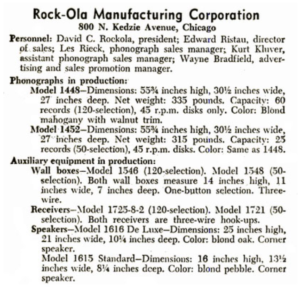
Meanwhile after the war: |
 |  |
Chief Guard J. T. Counihan of Rock-ola’s military police corps receives coveted Auxiliary Military Police Guidon citation from Capt. R. L. Stockman (right), military police supervisor for Sixth Service Command. David C. Rockola, president of Rock-ola’s Manufacturing Corporation, witnesses presentation. | WELCOME RETURNED HERO. Corp. Robert Graf (right), formerly an employee of Rock-Ola Manufacturing Corporation, is shown with David C. Rockola, president of the company. Corporal Graf, who had some narrow escapes from death in air action over New Guinea, for which he has been decorated, was surprised to find his employer now engaged in war production, as he worked in the plant when it was entirely devoted to the manufacture of coin machines and phonographs. Graf’s father and brother, both of whom work for Rock-Ola, are also in the army, so the poster in this picture has special significance for his family. |
David Rockola was the last big competitor joining the juke bussiness. Somewhere in the 30’s he was friendly asked by Wurlitzer and Seeburg to leave the market, as it was saturated they said.
Rockola did not change his vision and went onwards.
Allthough Wurlitzer and AMI ruled the 30’s and 40’s, and Seeburg did in the 50’s, it would be Rock-ola who became the market leader in the 60’s.
Rock-Ola was also the maker of shuffleboard tables from 1948 to 1950. Considered by collectors the Cadillac of shuffleboards due to their Art Deco styling with curving woodwork and much chrome, they are highly sought after by players.

Rock-Ola continued to manufacture jukeboxes into the 1970s and beyond, although the units themselves eventually became less conspicuous in the bars and clubs where they were located, ultimately being hidden away.
In the early 1980s, Rock-Ola produced video arcade machines, including Fantasy, (1981), Jump Bug (1981), and Eyes (1982). The most successful Rock-Ola arcade game was Nibbler.
Following David Rockola’s death in 1992 at the age of 96, his son Donald Rockola (who’d been running the firm for some time) elected to sell the family business after 65 years.
In 1992 Rockola sold the jukebox assets to Glenn Streeter of the Antique Apparatus Company who then consolidated jukebox manufacturing operations in his Torrance, California factory.
In 2019, A British company purchased Torrance-based Rock-Ola Manufacturing LLC, Alexander Walder-Smith the CEO of The Games Room Company, a high-end retailer of luxury entertainment products and longtime Rock-Ola distributor, purchased the privately held company from Rancho Palos Verdes resident Glenn Streeter, who acquired the Chicago company in 1992 and moved it to Torrance. Walder-Smith will keep the production in Torrance and as well as expand operations will launch a brand new vinyl 45 Jukebox in early 2020.

The founder, David Rockola, used to write his name without a scrap sign in the middle.
Since our great David was so fed up by his name being pronounced wrong all the time, he decided to put in the scrap sign in, when issuing the Rhythm Master jukebox in 1937.
That’s the reason why (nearly) all products carry the name Rock-ola.

Information is copied from www.kuijs.net/rock-ola and Wikipedia