Category Archives: Web Pages

Power distribution

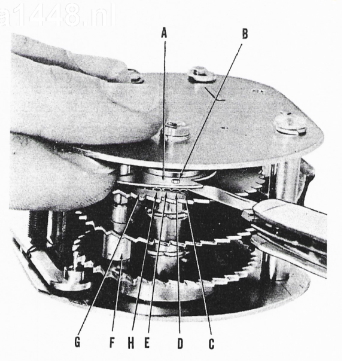
The power distribution panel assembly 18990-A of model 1448 is located at left side, when opening the interior from the back side.

Here’s a short description of all power outlets:
A – Turntable
B – Control box assembly, which submits the current to: Tone arm switch,
magazine motor, resetting selectors, gripper motor and volume control
in the amplifier.
C – Door : neon light

D – Amplifier
E – Door power: selection switches which activate selector coils, selection
roller motor, accumulator assembly.
F – Transformator 220 – 110 V, plus 110 V outlet.
G – Dome : neon light
H – Option : stepper / wallbox

All fuses 1x 1,6A, 2x 3A, 1x 10A are directely indicated in the picture.

Information is copied from www.kuijs.net/rock-ola
How the wallbox operates

How the wallbox operates

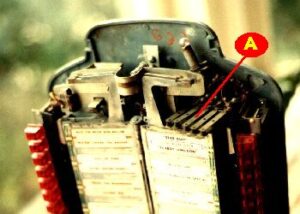
Inside the wallbox are five pages to be flipped mannualy. Each giving 10 selections per side.
Besides this there are two fixed pages.
This totals up to 120 selections.
By rotating the pages one of the 5 switches A can be activated.

After inserting a coin on top of the wallbox, it will activate the accumulator B while passing the slug rejector C

Now a choice can be made by pressing one of the twenty selector buttons D.
The dialer starts rotating. First the number of pages flipped E are counted: at each point it will send a pulse, until it will hit the point of the opened page, the system is short circuited and no pulses are sent anymore.
Than the selected button will get recognized in the same way, on one of the next 20 points F.
After the dialler has made a full circle, the pressed button D will be released, and return in its original position.

Information is copied from www.kuijs.net/rock-ola
Record Selection

All selections are recorded on the selector unit assembly:

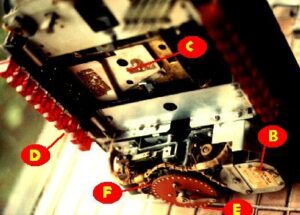
After pushing one of the selection buttons, the corresponding selector lever A on the selector unit will be pushed outward. Please notice the carriage assembly B , it will become more important later on.

The selection lever now also closes the circuit to the magazine motor A, which starts to rotate.
At the same time this picture shows the relative position of the magazine B, and selector unit C.

The magazine motor will keep on running, until the carriage assembly hits a selection lever. The magazine will rotate from record selection 119 to 1 (odds, main titles).

Than it reverses, and goes through no’s 2 to 120 (evens, or flip sides), and back again.

Once coming on the end of a full circle, a reversing switch A will be activated by trip brackets B.
This will change the direction of the current through the motor, and causes magazine to rotate in the opposite direction.


Information is copied from www.kuijs.net/rock-ola
Selection roller

When the coin is deposited, the select glass C will light up, and the program panel B is ready for use:

The program panel shows fourty selections on every panel. There are three seperate panels, which can be selected by pressing the program change button A.

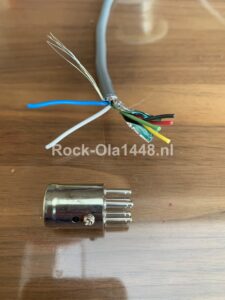
By depressing the program change button, a circuit A is closed to the motor, and the program change motor B starts to rotate, until switched off by the a 5 blade switch in the three groove cam C, after a 120 degree rotation.

Once stopped, the switch lever assemblies DG are in a fixed position (see diagram below).

The combination of switches D and F determine the position of the program panel by a notch in the wheel, and activates the first 20 selections on the corresponding panel.
Switches E and F activate the last 20 selections on one of the three selection panels.

The diagram below shows all possible switching:

By choosing one of the fourty selection buttons on the program panel, a selection on the selector unit assembly is made


Information is copied from www.kuijs.net/rock-ola
Free play

Converting to free play, coverting to payed or chang the amount of plays

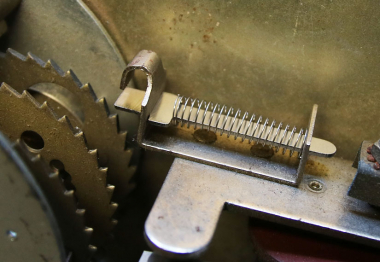
To convert the jukebox to free play (or other way around) is very simple just remove (or place)  the Credit unit reset pawl in the accumulator unit.

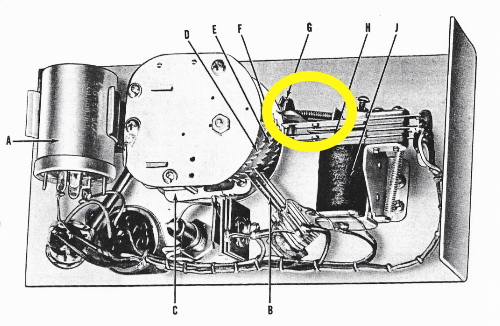
Below, the location of the accumulator unit (leftside in the middle)

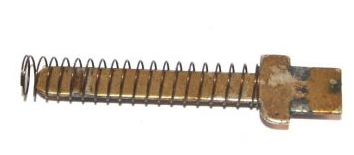
the reset pawl


Changing the amount of plays

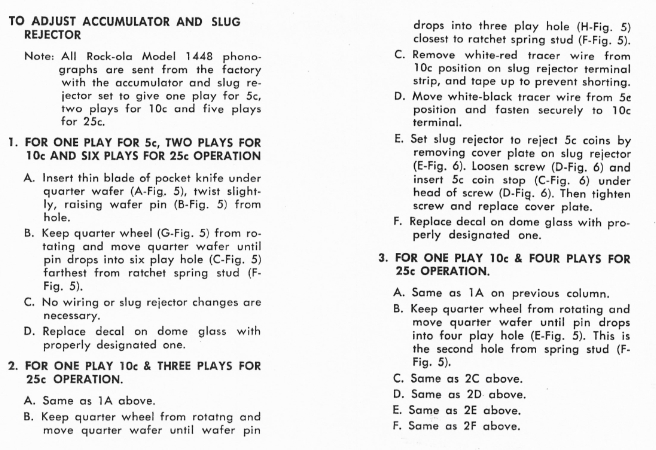
Default the jukebox will play one song for 5c, two plays for 10c and five plays for 25c, you can change this:

Idle Speed

Original the jukebox has 110V and 60Hz, in Europe with the step down transformer, it gets 110V and 50Hz

This means that the Turntable motor is running slower on 50Hz than on 60Hz.
To solve this you screw the conversion spring on top of the shaft of the turntable motor,  above the original 60 Hz. spring.

This increases the diameter to 5 – 5.1 mm. (use a Caliper to check the spring)

Do not remove the original 60 Hz. spring!

Sadly when I played a song on the jukebox is was howling (changing speed)

The original idler wheel was slipping on the turntable, I bought a new one.
After changing the wheel I noticed that is playing to fast, so bough a other one on a other website.

My collection Idler Speed wheels, the black-one is the original one and afer testing the bronze one (from  http://www.jukebox-world.de) gave exact 45 Rpm

To test the speed I used the RPM Turntable speed app from Philip Broder on my phone. (example for 33Rpm below)


Converting 240V to 110V

My Jukebox is imported from the USA and is designed for operation on 110V only. Next to a conversion to the European frequency of 50 Hz. it is needed to convert the voltage from 230V to 110V. Therefore a step down transformer is needed.

Since I read an article in a magazine about problems with the fact that in Europe the Voltage is boosted from 220V to 240V the step down transformers are giving also a higher voltage than 110V , I took my voltage meter and measured what my Transformer did and noticed that my voltage was 122V, this is not good (it should never be above 115V).

If the voltage is higher that 115V you can get fire or serious electric shocks, so be aware and do not trust you old step down transformer.

I also had a humming noise when I touched the metal of the jukebox, to solve both problems and give my jukebox a longer lifetime, I bought a Isolating Transformer at www.Jukebox-world.de

The new Isolating transformer, solved the humming noise and lowerd the heat of the TL Trafo and the turning table motor.

One of the best investments ever.

Isolating transformer,

My next challenge is going to be the 50Hz to 60 Hz conversing.