Category Archives: 1448-Jukebox

Control Box Assembly

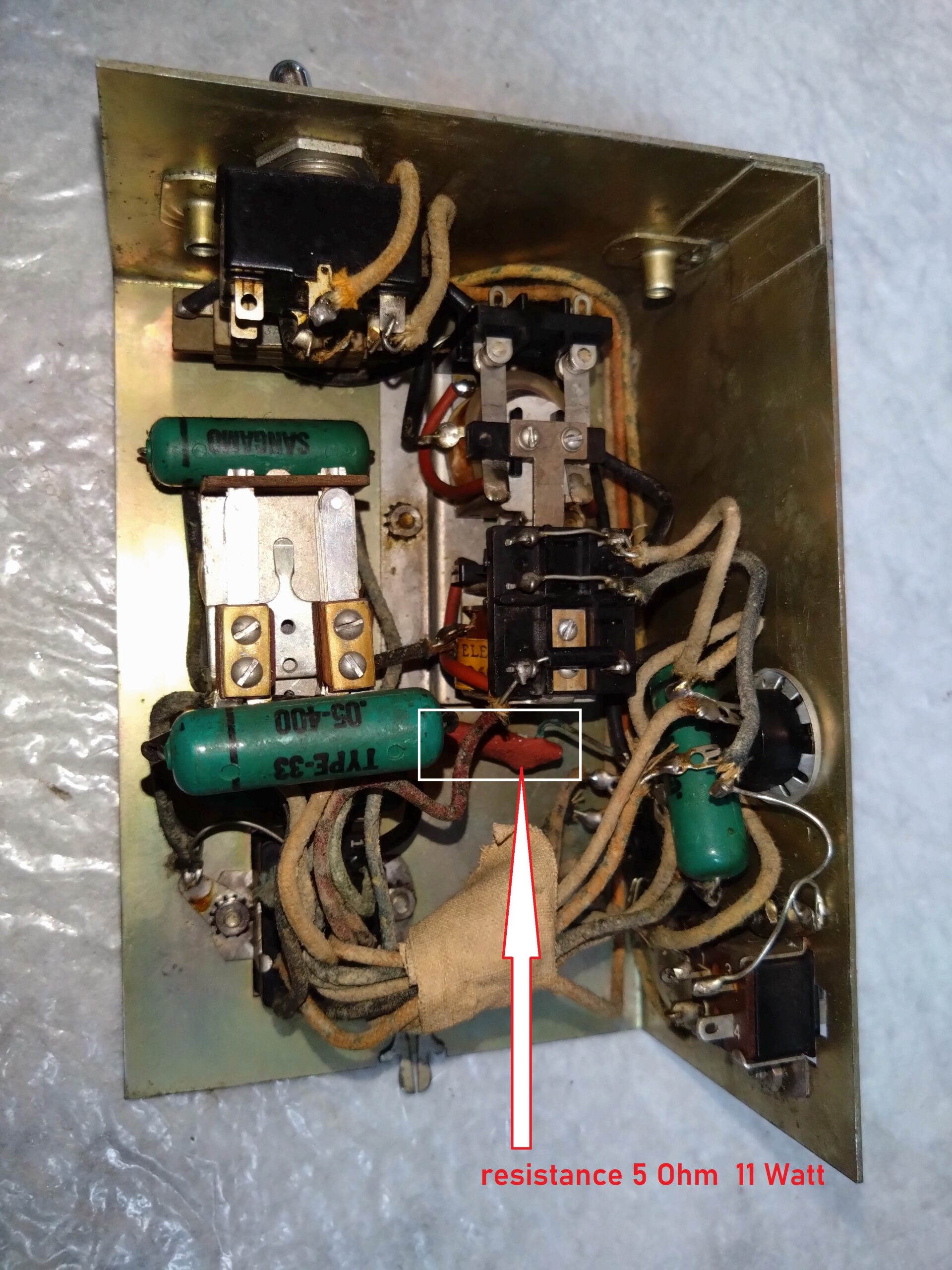
The control box has 2 switches for Record Load & Mech Power Switch, also it controls the Cancel Relay

Location of the Control Box

The control box assembly Part List:

Wire diagram

There’s something else exciting. The 5 ohm 11 watt resistor is not shown in the wiring diagram. Also not listed in the part list

Special Thanks to Ralph for providing the Article and Pictures

1448 Model differences

When I was seeking for part for my Rock-Ola 1448 I noticed that they made a lot of changes durring the two year production of the Jukebox and I think they made more changes on this model than on any other model.

What I noticed that the serial numbers go from : 144633 until 172931 (estimated amount made 29.000)  source

Between the early and late serial numbers you see that they started to mix parts.

Early serial numbers:

  • Orange amplifier, power supply, accumulator box and stepper

  • Orange surrounding of dress panel

  • Four triangle glass panels

  • Order of pushbuttons: Gold – Black or Gold & Black in pairs, numbering on drum in equivalent colours in pairs

  • Dress cap record player is Gold

Late serial numbers:

  • Blue amplifier, power supply, accumulator box and stepper

  • Blue surrounding of dress panel

  • Outside panels left and right are metal grills, two inside panels are triangle glass

  • Order of pushbuttons: Gold – Blue or Gold & Blue in pairs, numbering on drum in equivalent colours in pairs


  • Dress cap record player is Blue (I think it is the same as on the 1454 and do not know if those are repairs or originals, but when you search there are a lot of 1448 with a blue dress cap)

More pictures of the colors:

Popularity counter

The working of the popularity counter

To the strip guide of the small slide:
It is in the original a nylon band, which is fixed at one end is knotted on the small sledge. Then the belt runs to the right, “above” via one of the brass rollers; from there once completely around the large silver wheel on the mechanical center axle and from there back to the second brass roller and via a small mainspring back to the carriage.

The nylon strap is taken along on the large silver crown wheel via a small hole in the outer edge of the crown wheel, through which the Nylon cord is pulled, and where it is pulled with a small washer is knotted and thus secured against slipping.
The position “carriage” and “knotting point” of the nylon cord on the Crown wheel must, if no longer by the original constellation are determined experimentally.
It is best to place the sledge in the middle of the running track and pull the nylon cord (guided over the two brass rollers) half a Winding around the crown wheel (knotting hole of the crown wheel should of course in position “12 o’clock”). Then knot and secure there.
After that, the sledge should run nicely to the right and left and unwind or unwind the nylon cord on the crown wheel.

Build in: How the Base plate is mounted, you can see on the box. The big crown wheel should be plugged in together with the bracket and left loose become. The Bowden cable is hung at the top of the hole of the cam, which is replaced by the “black sheet with the recess” at the left end of the gripper shaft runs. The train is laid below the retaining plate of the Turntable. Holes with threads are already provided for this purpose.
Perlon rope (specialist dealer) with 1 mm diameter can be used for the rope become. This is hung with a loop on the left side of the car, runs then around the pulley on the left and then 2 times !!! around the big crown wheel, then right pulley and by means of spring to the right side of the Car.

Adjustment: After assembly, select plate 1 and mechanics before the Stop lifting the plate using a mechanical switch. Then the cart at the counter with the rear hook that is supposed to push the counting wheel, aligned to counter wheel 1 by turning the crown wheel. Now crown wheel tighten in the groove with the two square screws. The mechanics Continue running and observe whether the counter wheel 1 is pushed. Then check for plate 120 counters. Readjust if necessary.

The axle with the wheels must be very light to work well run, therefore clean well. Each counter wheel should move individually without pulling the neighbouring wheel.
By the way, the counter (game counter) is used when the plate is placed completely pulled through – to the correct length adjustment of the Bowden cables!

source

1448 Jukebox

Icicle (IJspegel in Dutch)

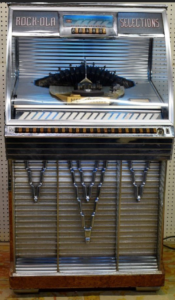
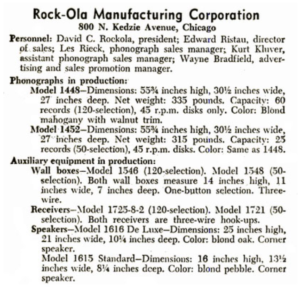
In 1955, Rock-ola introduced a new cabinet design in two new models, the Rock-ola 1448 and Rock-ola 1452 Jukebox. Both looking similar to the very popular 1954 Seeburg R Jukebox, having a similar mechanism glass dome, speaker grill design with triangle glass panels and Burled wood trime, the Rock-ola 1448 & 1452 were almost a direct copy of the Seeburg R Jukebox (picture below).

The Rock-ola 1448 was the premium model (featuring 120 selections, with rotating title drum). Both featured “Hi-Fi” sound with a load speaker and a horn tweeter. This model was used as basis for a wide range of models until 1958, it was the first to use a selection roller, a rotating drum with three blocks of 40 selections, making 120 selections available.

The Jukebox Rock-ola 1452 (featuring 50 selections), was for locations requiring only a limited number of selections as in areas where “country music” is all the rage or in college centers with a demand for the latest hit tunes, but demanding the finest in HI-FIDELITY MUSIC, Model 1452 has all the same outstanding features as model 1448 except for the smaller record storage and playing capacity. (picture below)

Specifications 1448:

  • Produced between 1955 – 56
  • Selections: 120, 45 rpm
  • Height: 142 cm, width: 76 cm, depth: 69 cm.
  • Weight: 157 Kg.
  • Amplifier: 19095-A / 19315-A
  • Power distribution: 18990-A
  • Stepper: 1725
  • Wallbox: 1546
  • Lamps: Cabinet 2x TL 20W/T/12/24″
  • Program and Select Light: 2x #44
  • Speaker: 1x 15″ + 1x Hi-Frequence rectangular horn
  • Cartridge: US: Astatic 51, Europe: Elac KST 103
  • Fuses: Amplifier: 3A, Credit unit: 0,1A, Power Supply: 1,6A, 2x 3A, 1x 10A
  • Cabinet Key: F-593

Know Serial numbers: 144633 until 172931 (estimated amount made 29.000)  source

There are a lot of small changes during the production, the things I found are on the 1448 model differences page

Accessories:

More information:

Pick a record

After pushing a selection button this cycle starts . . .

The carriage assembly B will move along the selector unit, until it hits a selection lever A , which has been put aside while selecting a record.

When the contact (B) in the carriage assembly hits (i.e. is grounded by) a selector lever, an interlock release contact will now change the current from the magazine motor to the gripper motor.


The gripper mechanism will now pick the record from the magazine and put it on the turntable.

Once this gripper arm has reached his rest position, it will close the circuit to the “selection lever reset solenoid” which puts back the selection lever with a spring plunger (A).

But let’s also pay some attention to the proces “under the hood”:

As the grippermotor A is activated, it will put the gripper drive shaft B to turn. This will activate the Geneva gripper plates  C, which in their turn will first activate the gripper mechanism D, and then the tone arm F.

The direction of the gripper arm, odd or even, is directed by the track roller in the magazine shaft, which is connected to the gripper mechanism with a rod F.

Cam switches G: one is for breaking the interlock trip coil, gripper motor and selection lever reset solenoid circuits, and the other completes a circuit to the interlock release coil.

Information is copied from www.kuijs.net/rock-ola

Amplifier

Here is an example of the amplifier 19096-A
ReferenceUS tube noEuropean tube no
 A5U4GZ 33
 B6L6KT 66
 C6L6KT 66
 D6 SN7 GTAECC32
 E6 SN7 GTAECC32

See 1448 Parts List

Other nice feature on the photo above:

F – Model 1448 was one of the first models which had a two way speaker system (see foto below), what was called high-fidelity sound, or, more common: HI-FI.


But not all customers were ready for this sound improvement, so on this amp-unit, a switch (F) was mounted to deliver the old sound. Which would mean that the tweeter would then be switched off, thus the sound only coming from the woofer!

Other tube replacements for other jukeboxes:

US tube noUS tube noEuropean tube no
 2 D 21EN 91
 5 V 4GZ 32
 5 AR 4GZ 34
 6 AU 6EF 94
 6 BA 6EF 93
 6 BQ 5EL 84
 6 X 4EZ 90
 12 AT 7ECC 81
712512 AU 7ECC 82
702512 AX 7ECC 83
6550 KT 88
6973 * 6 CZ 5
5879Seeburg V/VLdo not replace !
7199 do not replace !

* when using 6 SZ 5 tube :

  • Seeburg : no adjustments needed
  • Rock-ola : connect pins 1 and 8 in the socket.
  • Ami / WurliTzer: when pin 8 is used : connect pins 1 and 8.

Fuse: Amplifier: 3A,

Information is copied from www.kuijs.net/rock-ola


Power distribution

The power distribution panel assembly 18990-A of model 1448 is located at left side, when opening the interior from the back side.

Here’s a short description of all power outlets:
A – Turntable
B – Control box assembly, which submits the current to: Tone arm switch,
magazine motor, resetting selectors, gripper motor and volume control
in the amplifier.
C – Door : neon light

D – Amplifier
E – Door power: selection switches which activate selector coils, selection
roller motor, accumulator assembly.
F – Transformator 220 – 110 V, plus 110 V outlet.
G – Dome : neon light
H – Option : stepper / wallbox

All fuses 1x 1,6A, 2x 3A, 1x 10A are directely indicated in the picture.

Information is copied from www.kuijs.net/rock-ola

Record Selection

All selections are recorded on the selector unit assembly:

After pushing one of the selection buttons, the corresponding selector lever A on the selector unit will be pushed outward. Please notice the carriage assembly B , it will become more important later on.

The selection lever now also closes the circuit to the magazine motor A, which starts to rotate.
At the same time this picture shows the relative position of the magazine B, and selector unit C.

The magazine motor will keep on running, until the carriage assembly hits a selection lever. The magazine will rotate from record selection 119 to 1 (odds, main titles).

Than it reverses, and goes through no’s 2 to 120 (evens, or flip sides), and back again.

Once coming on the end of a full circle, a reversing switch A will be activated by trip brackets B.
This will change the direction of the current through the motor, and causes magazine to rotate in the opposite direction.


Information is copied from www.kuijs.net/rock-ola

Selection roller

When the coin is deposited, the select glass C will light up, and the program panel B is ready for use:

The program panel shows fourty selections on every panel. There are three seperate panels, which can be selected by pressing the program change button A.

By depressing the program change button, a circuit A is closed to the motor, and the program change motor B starts to rotate, until switched off by the a 5 blade switch in the three groove cam C, after a 120 degree rotation.

Once stopped, the switch lever assemblies DG are in a fixed position (see diagram below).

The combination of switches D and F determine the position of the program panel by a notch in the wheel, and activates the first 20 selections on the corresponding panel.
Switches E and F activate the last 20 selections on one of the three selection panels.

The diagram below shows all possible switching:

By choosing one of the fourty selection buttons on the program panel, a selection on the selector unit assembly is made


Information is copied from www.kuijs.net/rock-ola